

The Clear Mind Journal
Calm, Practical Guidance for Focus, Memory, and Everyday Mental Clarity
A Research-Based Guide Reveals a Practical 30-Day System to Help Young Adults Understand Everyday Forgetfulness, Improve Recall, and Stop Relying on Memory Alone

You reread the same paragraph for the third time. The words are familiar. The meaning is not.
Someone tells you their name, and thirty seconds later, it's gone. You smile and hope the conversation moves on before anyone notices.
You walk into a room to get something specific, and by the time you're standing there, you have absolutely no idea what it was.
You miss an appointment you were sure you'd remember. No reminder, no note — you were just going to "remember it."
A supervisor gives you an instruction. You nod, you understand it in the moment, and an hour later, half of it has quietly disappeared.
In a lecture hall, an office meeting, or a family conversation, you catch yourself drifting — and then feel the small, familiar panic of realising you missed something important.
Why can't I remember anything?
Is something wrong with my brain?
Am I becoming careless?
How will I pass this exam or keep up at work if this keeps happening?
If any of this feels familiar, you are far from alone. Many young adults — students, graduate trainees, entrepreneurs, and early-career professionals — quietly carry this same worry, often without saying it out loud to anyone.
Pause for a moment and read this carefully — because the explanation may be calmer, more practical, and more hopeful than you expect.
Memory Is Not One Single Skill
Here's something most people are never taught: "forgetting" is not one problem. It's usually one of several different things happening — and each one calls for a different response.
Sometimes information is never properly encoded in the first place, because attention was somewhere else when it arrived. Sometimes a distraction — a notification, a side conversation, a wandering mind — interrupts the exact moment something needed to be absorbed. Sometimes stress or exhaustion quietly disrupts the brain's ability to consolidate or retrieve information. Sometimes working memory is simply overloaded, trying to hold too many things at once. And sometimes, though less often than people fear, there is a health or psychological contributor that genuinely deserves a conversation with a qualified professional.
Once you can tell these apart, "I have a bad memory" stops being a vague, frightening label — and starts becoming something you can actually work with.
Why Am I Forgetting Everything? is a 42-page educational guide by Dr Oscar P. Davis, created to translate research on attention, memory, stress, sleep, digital distraction, learning, and personal organisation into practical steps for young adults.
This is not a miracle cure, a diagnosis, or a replacement for a doctor. It is a calm starting map.

A Composite Story: Understanding the Pattern
Consider this composite story — a realistic example created from the kinds of concerns many young adults describe. It is not a testimonial.
Ada is 22, in her final year at university in Port Harcourt. For most of her degree, she'd managed fine — not perfectly, but fine. Then final year arrived, with its heavier course load, a group project, and the quiet pressure of knowing graduation was close.
It started small. She'd sit through a lecture, nod along, and later realise she couldn't recall half of what was said. She'd read a chapter, close the textbook, and find that almost nothing had stuck. She began forgetting small conversations — what a coursemate had told her about a deadline, what her mother had asked her to do before the weekend.
She didn't tell anyone at first. Maybe I'm just tired, she told herself. But the pattern didn't go away. It got a little worse.
The private fear crept in slowly. Am I just not smart enough for this? Is something actually wrong with me? She started comparing herself to coursemates who seemed to retain everything effortlessly, and the comparison made the shame heavier.
Her breaking point came in the same week: she missed a project deadline she was certain she'd noted down somewhere, and she forgot half of a direct instruction from her supervisor during her internship — the kind of mistake that felt impossible to explain away.
That evening, she called her cousin, a few years older, who'd been through her own stretch of overwhelm during service year. Her cousin didn't offer a dramatic fix. She just said: "Stop guessing what's wrong. Look at the actual pattern first."
So Ada did. Over a few days, she noticed things she hadn't paid attention to before. Her sleep had become irregular — some nights four hours, some nights seven, no real rhythm. She almost always studied with her phone open beside her, glancing at it constantly. She multitasked without thinking about it: reading a textbook with a video playing in the background. When she studied, she reread the same pages instead of testing herself on them. She skipped meals more often than she liked to admit. And she kept every appointment, deadline, and task in her head, with no single place where any of it lived outside her memory.
None of this, on its own, felt like a big deal. Together, it explained a lot.
Ada started reading about how memory actually works, and one idea reframed things for her immediately: forgetting isn't one problem — it's usually one of five different things, and most of what she was experiencing traced back to attention, sleep, and stress, not to anything being "wrong" with her.
She also learned the basic path information has to travel to be remembered at all: Attention → Encoding → Consolidation → Storage → Retrieval. If attention is split at the very start — by a phone, by exhaustion, by stress — nothing downstream has much of a chance.
Instead of trying to fix everything at once, Ada built a small, realistic plan. She started putting her phone in another room during 25-minute study blocks. She set up one calendar and one task list, and made a rule: anything she needed to remember got written down immediately, not "remembered for later." After reading a chapter, she closed the book and tested herself on what she could recall, instead of rereading it. She reviewed material again after one day, then three days, then a week. She worked on steadier sleep and more regular meals. And she kept a short daily log of what she forgot, so she could actually see the pattern instead of just feeling anxious about it.
The first change she noticed wasn't a "perfect memory." It was something quieter: less mental overload, and fewer things slipping through the cracks. Nothing dramatic — just a a bit more room to breathe.
By the second and third week, she felt more organised. Information she studied using active recall stuck noticeably better than material she'd only reread. She wasn't chasing her own memory as much, because more of it now lived in a calendar and a notebook instead of only in her head.
She also learned something else worth knowing: not everything should be self-managed. While reading through the guide's chapter on physical and psychological contributors, she wrote down a few questions of her own — about her energy levels and irregular sleep — to eventually raise with a doctor, rather than guessing at answers online.
Ada's experience isn't a dramatic transformation story, and it isn't meant to be one. It illustrates something simpler and more useful: reliable memory is supported by attention, healthy routines, evidence-based learning techniques, and external systems — not by shame, and not by magical thinking.
That is why the complete system has been organised into one calm, easy-to-follow guide.
Inside it, you will find the explanations, practical exercises, self-checks, worksheets, red-flag guidance, and the full 30-day plan in one place.
Introducing…
Why Am I Forgetting Everything?
A Calm, Evidence-Based Guide to Attention, Memory, and Everyday Forgetfulness for Young Adults
By Dr Oscar P. Davis
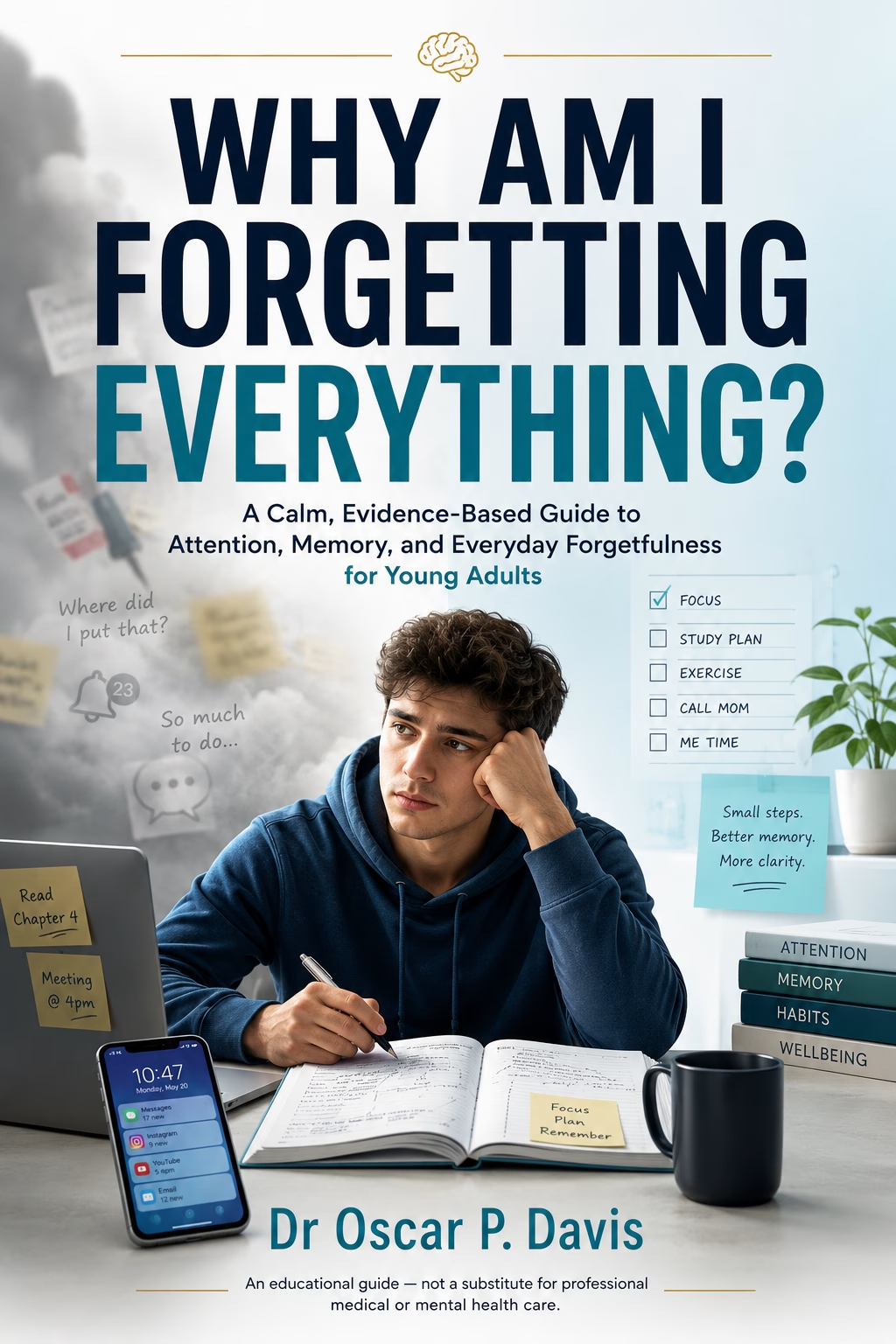
What Is Inside the Guide
Inside this evidence-based e-guide, you'll discover:
- Why "forgetting" can mean five different things — and why each one needs a different response (Pages 6–8)
- The memory pipeline: Attention → Encoding → Consolidation → Storage → Retrieval (Pages 9–10)
- A Lifestyle Memory Audit covering sleep, screens, exercise, hydration, meals, routines, substances, and caffeine (Pages 11–13)
- The stress–forgetting loop, plus practical grounding and simplification exercises (Pages 14–16)
- A distraction-reduction system for phones, notifications, multitasking, instructions, and focused work (Pages 17–19)
- Physical and physiological factors worth discussing with a qualified healthcare professional — B12, iron, thyroid function, blood sugar, hormones, sleep apnoea, medications, vision, and hearing (Pages 20–22)
- A clear urgent-versus-routine decision guide explaining when forgetfulness may need medical attention (Pages 23–25)
- Evidence-supported memory techniques: active recall, spaced repetition, chunking, association, visualisation, teaching, and practical applications (Pages 26–28)
- The "Second Brain" system using one calendar, one task manager, notes, checklists, reminders, habit stacking, and weekly reviews (Pages 29–31)
- A realistic 30-Day Memory Reset Plan organised into four weekly stages (Pages 32–33)
- Bonus worksheets and practical resources — a Memory Symptom Tracker, Doctor-Visit Preparation Worksheet, Workplace Instruction Template, Study-Retention Planner, Seven-Day Digital Distraction Detox, Sleep and Energy Audit, and scripts for requesting repeated instructions (Pages 34–36)
- A glossary, bibliography, final action plan, and author information (Pages 37–42)
And the best part? You do not need to chase miracle supplements, keep dozens of productivity apps, or depend on willpower alone. You will have one structured map for understanding the problem, strengthening recall, reducing avoidable distraction, and building reliable systems around your life.
What Readers Can Use This Guide For
C.O., a student in Enugu — could use the active recall and spaced-review method to work through lecture material instead of rereading notes the night before an exam.
B.T., a graduate trainee in Lagos — could use the Workplace Instruction Template to write down each task, deadline, and clarifying question during onboarding, instead of relying on memory alone.
D.K., a creator in Abuja — could use the "Second Brain" system to move scattered ideas and deadlines out of their head and into one calendar and one task list.
F.A., serving with NYSC in Ibadan — could use the Appointment Tracker and daily capture habit to stop missing CDS meetings and community commitments.
N.E., a young entrepreneur in Port Harcourt — could use the weekly review habit to keep supplier follow-ups, client conversations, and business tasks from living only in their head.
What Went Into This 42-Page Guide
- Reviewing and organising research across cognitive science, psychology, sleep, attention, learning, and behavioural health
- Translating technical findings into plain, non-clinical language
- Structuring ten chapters and a realistic 30-day action plan
- Creating printable trackers, planners, audits, and scripts
- Editing, formatting, illustrating, and designing a 42-page guide
- Compiling a transparent bibliography of named, publicly accessible sources
One payment. Immediate access to the downloadable PDF through the checkout platform.
The ₦5,000 introductory price is available for a limited launch period. Any future price change will be displayed clearly on this page.
Get "Why Am I Forgetting Everything?" Now — ₦5,000Secure checkout. Your download will be delivered according to the checkout platform's fulfilment process.
Your Practical Worksheet Bonuses
Bonus 1: 30-Day Memory Reset Action Pack
A printable implementation set for the four weekly stages: identify the problem, repair attention, strengthen recall, and build long-term systems.

Bonus 2: Study, Work, and Doctor-Visit Worksheet Pack
Printable copies of the Memory Symptom Tracker, Doctor-Visit Preparation Worksheet, Workplace Instruction Template, Study-Retention Planner, Sleep and Energy Audit, and instruction-repetition scripts.


What Happens After Purchase
Informational sequence only — not a real chat log or payment notification.
You are not buying a miracle. You are getting a practical, evidence-based map you can work through at your own pace.
Get "Why Am I Forgetting Everything?" Now — ₦5,000Still Unsure? Here Is the Fair-Purchase Promise
Read the guide, review the worksheets, and begin the first steps. If you believe the guide was materially misrepresented on this page, contact us within seven days of purchase and we will review your refund request in line with the stated refund policy.
Medical Disclaimer: This guide is for general educational and informational purposes only. It does not diagnose, treat, cure, or prevent any medical, psychological, or psychiatric condition and is not a substitute for professional medical or mental-health care. Always consult a qualified healthcare professional about persistent, worsening, sudden, or concerning symptoms.
If you need urgent support: If you experience sudden confusion, memory loss after a head injury, new weakness or numbness, difficulty speaking, a seizure, a severe headache with neurological symptoms, or unexpected disorientation in a familiar place, seek urgent medical attention.
Frequently Asked Questions
Is this guide a medical diagnosis?
No. It is an educational resource. It does not diagnose any condition, and it isn't a substitute for a consultation with a qualified healthcare professional.
Does it cure memory loss?
No. It does not claim to cure, treat, or prevent memory loss or any medical condition. It offers education and practical, evidence-informed habits.
Is ordinary forgetfulness the same as dementia?
No. Everyday forgetfulness in a healthy young adult is usually explained by attention, sleep, stress, or lifestyle factors. The guide explains this distinction clearly, along with genuine warning signs that deserve medical attention.
Who is this guide for?
Primarily young adults aged 16–35 — students, NYSC members, graduate trainees, creators, and early-career professionals — who want a calmer, more structured understanding of their attention and memory.
What if my symptoms are sudden or rapidly worsening?
This guide is not designed for that situation. If symptoms are sudden, rapidly worsening, or affecting your safety or daily functioning, seek medical attention rather than relying on this or any self-help resource.
Does the guide discuss ADHD?
Yes, at an educational level, including why online checklists cannot diagnose ADHD and why a proper clinical evaluation matters.
Will I need special apps or supplements?
No. The guide deliberately avoids recommending specific apps or supplements. It focuses on simple, low-cost systems — one calendar, one task list, and evidence-supported habits.
How much time does the 30-day plan require?
Roughly 15–30 minutes a day, organised into four weekly stages, with a lighter maintenance phase afterward.
Can I use the worksheets on my phone?
Yes. The PDF can be viewed on a phone, tablet, or computer, and the worksheets can be printed or filled in digitally, depending on your device and PDF reader.
How will I receive the PDF after payment?
Delivery follows the checkout platform's standard fulfilment process after your payment is completed.
Two Ways Forward
Option 1: Take a calm, structured step. Use the guide to understand your patterns, reduce avoidable distraction, strengthen recall, and build systems that stop important things from living only in your head.
Option 2: Keep guessing, blaming yourself, and trying disconnected tips without a clear plan.
You do not need perfect memory. You need a better understanding of how memory works — and a reliable system that supports it.
Download "Why Am I Forgetting Everything?" + Bonuses — ₦5,000Educational resource only. Not medical advice. Results vary. Seek qualified professional care for sudden, worsening, persistent, or concerning symptoms.